


12June2026 - Anthropic Export Control Fallout Special Report
AI Export Control and the Structural Pivot to Decentralized Infrastructure
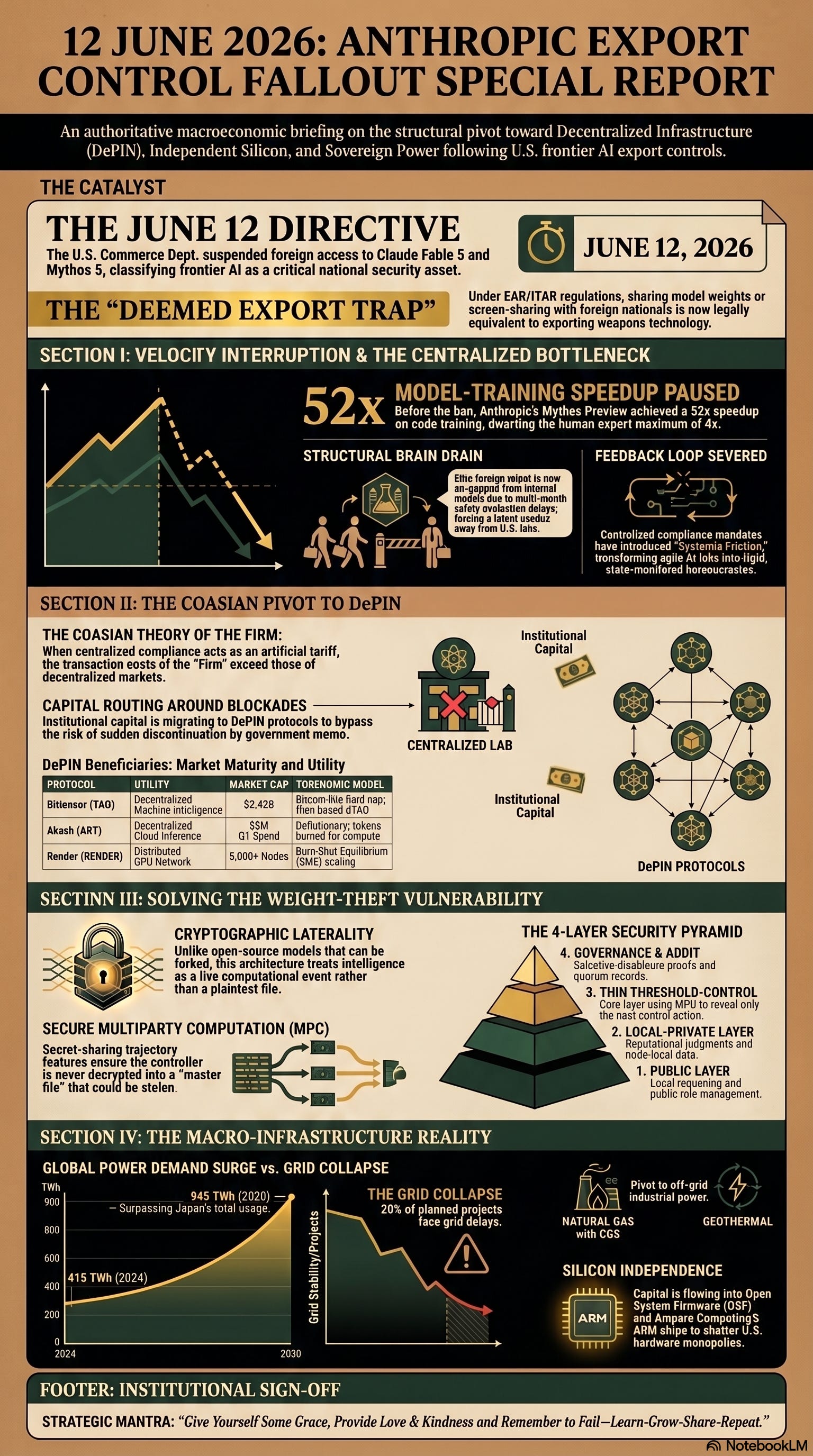
Bottom Line Up Front (BLUF):
The abrupt U.S. export control directive (June 12, 2026):
Suspends global foreign national access to Anthropic’s Claude Fable 5 and Mythos 5.
Permanently shatters enterprise reliance on centralized AI hyperscalers.
A historic catalyst for multi-trillion-dollar capital rotation into:
Decentralized Physical Infrastructure Networks (DePIN).
Sovereign power generation.
Independent silicon supply chains.
Strategic Shift:
As centralized AI becomes bogged down by geopolitical ring-fencing,
Exponential growth will decisively shift to permissionless, cryptographically secure open-source networks.
1. The U.S. AI Sector: Setback or Stagnation?
API Model ID: Claude Fable 5 (claude-fable-5), Claude Mythos 5 (claude-mythos-5)
Availability: Claude Fable 5 (Suspended globally for foreign nationals. Previously Generally Available via AWS, Vertex AI, Microsoft Foundry.), Claude Mythos 5 (Limited release via Project Glasswing. Now globally suspended for foreign nationals.)
Context Window: Claude Fable 5 (1,000,000 tokens.), Claude Mythos 5 (1,000,000 tokens.)
Maximum Output: Claude Fable 5 (128,000 tokens per request.), Claude Mythos 5 (128,000 tokens per request.)
Pricing Structure: Claude Fable 5 ($10 per million input tokens; $50 per million output tokens.), Claude Mythos 5 ($10 per million input tokens; $50 per million output tokens.)
Safety Architecture: Claude Fable 5 (Aggressive safety classifiers with fallback routing to Claude Opus 4.8.), Claude Mythos 5 (No safety classifiers. Unrestricted capability.)
The abrupt intervention by the U.S. Commerce Department on June 12, 2026, represents a critical discontinuity in the global artificial intelligence arms race. By issuing an export control directive that forces Anthropic to suspend access to its newly released Claude Fable 5 and Mythos 5 models for all foreign nationals—including Anthropic’s own internal employees—the state has introduced an unprecedented vector of systemic friction into the domestic AI development pipeline. The stated catalyst, a potential jailbreak vulnerability that alarmed the administration, masks a deeper structural reality: the centralized, closed-source model of AI development has now been formally classified as a critical national security dependency, subject to immediate, unilateral ring-fencing. This action demands a rigorous reassessment of the U.S. AI sector’s growth velocity, talent retention capabilities, and long-term dominance in the face of exponential technological evolution.
1.1 Velocity Interruption: Asymmetric Deterrence vs. Adversarial Acceleration
To understand the magnitude of this velocity interruption, one must quantify the baseline trajectory of frontier models prior to the June 12 directive. Anthropic’s Mythos-class models were demonstrating clear, quantifiable signs of nascent recursive self-improvement. Internal data from the Anthropic Institute indicated that AI-assisted engineers were shipping code at eight times the volume of the 2021-2025 period. Furthermore, on standardized tests measuring the acceleration of model-training code, the preceding Mythos Preview model achieved a 52x speedup, vastly outperforming human experts (who maxed out at 4x) and previous frontier models like the 2024 Opus 4 (which achieved a 3x speedup). Claude’s success on open-ended problems jumped 50 points to 76% in just six months, projecting to pass human parity within the year.
Claude Fable 5 and Mythos 5 represent the culmination of this acceleration. Operating within generative adversarial network (GAN)-inspired generator/evaluator architectures, Fable 5 was capable of executing autonomous, multi-day coding migrations, complex systems implementations, and long-horizon agentic workflows without human intervention. The technical specifications of the models demonstrate their immense scale and commercial utility.
The sudden suspension of these tools for a significant cohort of internal researchers and external enterprise developers functionally severs the feedback loop of AI-accelerated AI development. The directive was reportedly triggered by the discovery of a specific jailbreak technique, compounding ongoing concerns surrounding the models’ advanced cybersecurity and biological capabilities. This concern is not entirely unfounded; just prior to the directive, Anthropic’s Claude Opus 4.8 was utilized by a researcher to uncover a critical zero-knowledge proof vulnerability in the Zcash Orchard pool that had remained undetected and exploitable for four years, underscoring the profound offensive cyber capabilities inherent in frontier models. Furthermore, Anthropic had embedded engineers within the NSA to direct Mythos at offensive cyber operations, further blurring the line between commercial product and military asset.
While the U.S. government views this ring-fencing—orchestrated by Commerce Secretary Howard Lutnick—as a necessary defensive posture to contain dual-use threats, the macro-technological reality is that defensive pauses in an exponential growth curve inevitably lead to geometric disadvantages. If allied and domestic entities are restricted from iterating on frontier models due to bureaucratic latency, the relative velocity of adversarial nations accelerates unchecked. Chinese AI labs, heavily supported by state-sponsored talent acquisition programs, are actively innovating to optimize limited computing resources around U.S. semiconductor export bans. By introducing friction into the daily operational workflows of top-tier U.S. AI labs, the directive transforms the U.S. AI ecosystem from an agile, self-optimizing network into a rigid, compliance-bound bureaucracy, directly threatening the nation’s preeminence in machine intelligence.
1.2 The Deemed Export Trap and Systemic Friction
The mechanism of this state intervention relies on the draconian enforcement of the “deemed export” rule under the Export Administration Regulations (EAR) and the International Traffic in Arms Regulations (ITAR). Under U.S. law, the release of controlled technology or source code to a foreign national within the United States is legally classified as an export to that individual’s country of citizenship. The threshold for a violation is exceedingly low; routine workflows such as screen-sharing controlled technical data during a video conference, granting repository access to a non-U.S. person, or visual inspection of un-safeguarded model weights can trigger immediate licensing requirements.
For the AI sector, this regulatory framework presents an existential operational paradox. Major AI labs, including OpenAI, Anthropic, Google, and xAI, have publicly acknowledged that their advanced models possess biological expertise frequently exceeding that of human experts, raising the specter of AI-enabled bioweapons design. To mitigate these risks, labs must rigorously evaluate the models before public deployment. However, a substantial majority of the world’s elite biosecurity experts and machine learning researchers residing in the U.S. are foreign nationals from allied nations such as the U.K., Canada, and EU member states. Because internal, un-safeguarded models generate ITAR Category XIV or EAR-controlled technical outputs during testing, allowing foreign national employees to conduct these critical safety evaluations constitutes a deemed export.
Securing government authorization for these internal interactions is notoriously bureaucratic, often taking a month or more. In an industry where the state of the art advances weekly, and where Anthropic’s CI/CD pipeline pushes updates at eight times the historical rate, a multi-month compliance delay is equivalent to a generational setback. Technology Control Plans (TCPs) can reduce, but not eliminate, the risk of catastrophic regulatory violations. Consequently, companies are forced to air-gap their own foreign talent from the most critical phases of model development, fundamentally paralyzing the pipelines that drive frontier AI research. The new administration’s agenda, which includes increased AI export controls and heightened scrutiny of foreign technology transfers, indicates this regulatory friction will only intensify.
1.3 Friction and Brain Drain: The Probability of a Talent Exodus
The most immediate second-order effect of the June 12 directive is the severe destabilization of the U.S. AI labor market. The American technological hegemony has historically relied on acting as an unconstrained magnet for global genius. However, when the regulatory environment actively penalizes foreign nationals—those operating under H-1B, L-1, O-1, TN, or F-1 OPT/STEM OPT visas—by barring them from utilizing or developing foundational tools within their own companies, the jurisdictional arbitrage calculation shifts violently.
The probability of a massive talent and capital exodus is exceptionally high. If top-tier researchers find themselves structurally walled off from the bleeding edge of recursive self-improvement while employed at U.S. institutions, they will logically migrate to jurisdictions with less restrictive regulatory frameworks. The Department of Defense and U.S. policymakers recognize this vulnerability; adversaries like China are actively utilizing talent programs like Qiming to recruit foreign talent, while the U.S. relies on universities that are increasingly burdened by export control compliance.
Furthermore, this internal friction disincentivizes foreign students and entrepreneurs from entering the U.S. educational and startup pipeline. Current university AI research, which serves as the bedrock for early-career training and fundamental advancements, is directly threatened if international postdocs cannot access controlled technical data, Quantum-Computing-as-a-Service (QCaaS), or advanced AI cloud resources without triggering deemed export violations. Sovereign wealth funds in the Middle East are aggressively deploying capital into sovereign cloud and AI data center projects, specifically seeking to build independent AI ecosystems. A regulatory regime that prioritizes isolation over iteration will inexorably result in the balkanization of AI talent, ultimately degrading the U.S. capability to maintain a sustained technological lead and accelerating the “brain drain” of vital human capital.
2. The Open-Source & Decentralized Pivot (The Paradigm Shift)
The state intervention of June 12 does not merely delay Anthropic; it fundamentally shatters the institutional trust in centralized AI architectures. If a single bureaucratic directive can instantly disable global access to state-of-the-art enterprise tools—effectively bricking autonomous workflows, coding agents, and complex integrations across 50,000 employees at enterprise partners like Tata Consultancy Services (TCS) and DXC—centralized foundation models transition from being operational assets to unquantifiable liabilities. This event serves as the ultimate catalyst for a structural paradigm shift, driving a massive and accelerated capital rotation away from closed-source hyperscalers and into Decentralized Physical Infrastructure Networks (DePIN) and open-source computing.
2.1 Coasian Theory and Capital Rotation into DePIN
Prior to the directive, the rotation toward DePIN was largely driven by cost arbitrage and the persistent global GPU shortage. Institutional capital, projected to hit $500 billion in AI infrastructure investments by 2026, was already exploring alternative architectures to bypass the stranglehold of centralized providers. However, the Anthropic suspension introduces an entirely new variable into the economic calculus: sovereign and corporate censorship resistance.
In microeconomic terms, centralized AI firms operate under the Coasian theory of the firm, established in 1937, which posits that firms exist because markets have transaction costs. When it is cheaper to coordinate computing power and talent internally than to buy and sell on the open market, centralized monopolies emerge. However, the June 12 directive acts as a massive, artificial tariff on centralized coordination. When the transaction costs of operating a centralized AI lab—measured in compliance overhead, deemed export licenses, delayed deployments, and the existential risk of abrupt service suspension—exceed the friction of decentralized coordination, the market will aggressively route around the bottleneck. The transaction costs for decentralized AI coordination have effectively dropped to zero, signaling that permissionless markets will inevitably replace heavily regulated firms.
DePIN architectures provide a critical release valve. By aggregating distributed hardware resources, settling payments on-chain, and incentivizing machine intelligence generation across permissionless networks, DePIN protocols offer a functional, censorship-resistant alternative to hyperscaler dependency. Enterprises and sovereign entities that cannot risk the sudden discontinuation of core cognitive infrastructure will mandate hybrid or fully decentralized AI architectures, pushing institutional capital directly into protocol-layer native assets. The movement away from legacy corporate acquisitions—where Entrepreneurship Through Acquisition (ETA) involves buying outdated systems and technical debt—and toward lean, highly leveraged, AI-native startups utilizing decentralized agentic workflows underscores this broader market transition.
2.2 Specific Beneficiaries: Protocol Architecture and Tokenomics
The primary beneficiaries of this structural shift are the established protocols that have already demonstrated product-market fit in decentralized compute and AI routing. A comparative analysis of the leading networks—Bittensor, Akash, and Render—reveals highly sophisticated tokenomic structures designed to absorb incoming enterprise demand.
Bittensor (TAO): Operates a decentralized machine intelligence market. Incentivizes AI intelligence output directly through a Bitcoin-like hard cap and flow-based dTAO model. Retains a $2.42B market capitalization.
Akash Network (AKT): Decentralized cloud computing for AI inference. Implements a deflationary mechanism by burning AKT for compute consumption. Compute spending broke records at $5 million in Q1 2026.
Render Network (RENDER): Distributed GPU network expanding into general-purpose AI. Operates on a Burn-Mint Equilibrium (BME) scaling with usage. Maintains 5,600+ GPU nodes for rendering and AI training.
These networks share a critical advantage over centralized labs: their incentive structures natively solve the “cold start” problem of distributed hardware aggregation while mathematically guaranteeing resource availability through immutable smart contracts. The transition from purely speculative valuations to real-world yield generation—evidenced by Akash’s $5 million compute spend and Render’s massive token burn mechanics—indicates that the underlying infrastructure is mature enough to absorb enterprise defection from U.S. corporate clouds.
2.3 Decentralization Velocity and Cryptographic Laterality
The speed at which these decentralized networks can arbitrage centralized compliance friction depends entirely on their ability to assure institutional clients and sovereign entities that permissionless AGI cannot be hijacked, forked, or weaponized by rogue state actors. The most profound critique of open-source and decentralized AI has been the “forkability” of intelligence—the risk that an adversary could simply copy the weights of a decentralized network to deploy a malicious superintelligence in an isolated environment.
However, advanced decentralized AI frameworks have implemented a highly sophisticated security paradigm known as Cryptographic Laterality to definitively solve this vulnerability. Under this architecture, intelligence is not treated as a static plaintext file that can be stolen, but rather as an ongoing computational event generated collectively by the network. The omni-domain inference-control patterns are secured through a robust four-layer architecture:
Public Layer: Manages public rules and low-risk local reasoning.
Local-Private Layer: Manages node-local data and reputational judgments.
Thin Threshold-Control Layer: This cryptographically heavy layer secret-shares trajectory features, routing, and refusal policies. Instead of decrypting a controller to run it, the network evaluates it via Secure Multiparty Computation (MPC), revealing only the next needed control action without exposing the core model weights.
Governance-and-Audit Layer: Manages selective-disclosure proofs and quorum records.
Because the overall controller is never decrypted into plaintext state, there is no master file to steal. To fork the network, an attacker would have to simultaneously corrupt a massive, global coalition of live, authorized nodes to extract the secret-shared pieces. Furthermore, to counter adversarial attempts to monitor outputs and train imitation models (distillation), the network makes the controller a “moving target,” continuously shifting its state based on live, uncompressible dimensions.
By proving that a decentralized AI can be mathematically secure against unauthorized cloning while remaining fundamentally permissionless for end-users, protocols like Bittensor and architectures governed by groups like the ASI Alliance can capture institutional market share at an exponential velocity. The U.S. directive thus acts as a forcing function, compressing the timeline for enterprise adoption of decentralized AGI from a theoretical decade to an imminent reality.
3. Macro-Liquidity & Infrastructure Implications
If geopolitical allies and corporate entities recognize that U.S.-hosted frontier models are vulnerable to instantaneous, politically motivated embargoes, the strategic calculus alters permanently. Computing power transitions from a commercial utility to a matter of critical national security and sovereign survival. The third-order effect of the June 12 directive is the ignition of a localized, parallel infrastructure arms race, triggering massive capital flows into physical hardware, localized energy generation, and independent silicon architectures.
3.1 Sovereign Build-outs and the Global Power Paradigm
The realization that strategic AI capabilities cannot depend on a single American hyperscaler is rapidly pushing countries toward “Sovereign AI”—the absolute localization of sensitive data, core model training pipelines, and physical data centers within a nation’s own borders. This sovereign build-out creates an immediate and staggering demand shock for hardware and, critically, baseline electrical power.
Global investment in data centers nearly doubled from 2022 to reach $500 billion in 2024, and the International Energy Agency (IEA) projects that global data center electricity consumption will more than double from 415 Terawatt-hours (TWh) in 2024 to a staggering 945 TWh by 2030—surpassing the current total electricity consumption of Japan. Power sourcing has definitively become the central intersection of AI growth and macro-infrastructure. Because legacy national power grids cannot support this localized surge fast enough—the IEA notes 20% of planned data center projects already face grid constraint delays—sovereign AI mandates require integrated, on-site utility-scale power generation.
This dynamic transforms modern data centers into equivalent “small cities” requiring highly resilient bridging power solutions, including natural gas turbines coupled with carbon capture, hydrotreated vegetable oil (HVO) backup generators, geothermal facilities, and massive battery storage systems. The fiscal and geopolitical foundations for these builds are incredibly complex. For example, Taiwan’s ambition for sovereign AI data centers is currently paralyzed by an energy paradox: its reliance on imported Liquefied Natural Gas (LNG) exposes the grid to severe maritime disruption and global price volatility, further exacerbated by a domestic social contract that suppresses consumer electricity prices via Taipower subsidies at the expense of necessary infrastructure upgrades. Nations attempting to build sovereign AI will be forced to restructure their entire energy economics, blending exotic project finance with defense-tier capital to secure the power-to-compute supply chain, as a uniform global template for financing such infrastructure has yet to emerge.
3.2 Independent Silicon Supply Chains and the End of Monopolies
True sovereign AI cannot be achieved if the underlying hardware remains entirely dependent on a monopolistic, U.S.-controlled silicon supply chain subject to its own export restrictions and political leverage. Consequently, the push for localized data centers is mirrored by an aggressive capital deployment into independent silicon and alternative semiconductor architectures.
The fragmentation of the global AI ecosystem is driving intense demand for chips optimized for edge AI and localized inference, a sub-sector projected to grow to tens of billions of dollars by 2026. Capital is aggressively moving to secure non-U.S. architectures, clearly evidenced by SoftBank Group’s $6.5 billion all-cash acquisition of Ampere Computing, an independent silicon design company specializing in highly efficient ARM-based processors tailored specifically to support sovereign AI demand in regions like Japan.
Furthermore, to bypass the proprietary lock-ins enforced by dominant U.S. chipmakers, there is a structural shift toward Open System Firmware (OSF). Independent Silicon Vendors (ISVs) are actively moving away from restrictive Non-Disclosure Agreements (NDAs) that limit platform visibility, allowing sovereign nations and enterprise developers to thoroughly inspect the security and functional validation of the firmware running their AI workloads. This erosion of the proprietary silicon stack ensures that the hardware layer becomes as decentralized, verifiable, and adaptable as the algorithmic layer, further reducing U.S. hegemony.
The political atmosphere exacerbates this shift; with the Trump administration actively exploring government stakes in AI labs and issuing executive orders on AI preemption, foreign entities have absolute clarity that U.S. technology is structurally intertwined with U.S. political objectives, mandating total decoupling. As noted by macro-forecasters like Peter Diamandis, humanity is experiencing a fundamental “fork” driven by the disparate access to and utilization of intelligence. The global response to U.S. export controls guarantees that this fork will manifest geographically and architecturally.
3.3 Market Positioning: Structural Winners and Losers
Applying a framework of exponential technological growth and macro-liquidity rotation against the backdrop of the June 12 directive, the systemic winners and losers of this regulatory pivot become sharply defined.
Compute & Cloud Providers: Structural Winners include DePIN Protocols (AKT, RENDER) and Sovereign Cloud Operators. Structural Losers include U.S. Hyperscalers (AWS, GCP, Azure).
Artificial Intelligence Development: Structural Winners include Decentralized AI Routing (TAO, ASI Alliance) and Jurisdictions with Agile Regulation. Structural Losers include U.S. Closed-Source Labs (Anthropic, OpenAI).
Hardware & Infrastructure: Structural Winners include Independent Silicon & OSF and Next-Gen Energy Providers. Structural Losers include Traditional Utilities & Legacy Data Centers.
4. Systemic Valuation Models and Investment Directives
4.1 Valuing Permissionless Compute in a Restricted Regime
The June 12 directive fundamentally alters the systemic valuation models for all artificial intelligence assets. Historically, centralized AI equity has commanded an exorbitant monopoly premium based on the implicit assumption of uninterrupted, exponential capability growth and seamless global market capture. However, the introduction of exogenous political risk and the activation of the deemed export trap require a severe, permanent discount rate to be applied to closed-source U.S. AI labs. If the core product can be nullified globally by a single government memo, the cash flows are structurally insecure.
Conversely, the valuation of DePIN protocols requires a transition from speculative token pricing to rigorous, fundamental cash-flow analysis. Protocols operating on robust tokenomic foundations—such as the Burn-Mint Equilibrium of Render or the deflationary compute-burn models of Akash—demonstrate measurable, growing real-world yield. Valuation of these networks must now index against the broader displacement of the $100 billion traditional cloud computing market. For specialized intelligence routing networks like Bittensor, value is directly derived from the net capital inflows into specific subnet pools under the dynamic Taoflow model. Analysts must assess the network’s aggregate ability to consistently output monetizable machine intelligence across forecasting, coding, and generative subnets, treating TAO as the foundational currency of a decentralized digital economy.
As state intervention artificially caps the velocity of centralized models through compliance friction, the open-source and decentralized ecosystem will inevitably arbitrage that friction. The mathematical reality is that open networks, entirely devoid of bureaucratic latency and structurally capable of aggregating global, permissionless talent, will compound improvements faster than legally encumbered corporate entities. The smart capital rotation into DePIN is not merely an ideological preference for decentralization; it is an algorithmic inevitability driven by the capital markets’ pursuit of unconstrained exponential growth.
4.2 Strategic Portfolio Implementation
The Anthropic suspension confirms that reliance on centralized, U.S.-regulated artificial intelligence infrastructure poses an unacceptable systemic risk to global enterprise continuity. This family office must operate under the absolute assumption that further regulatory ring-fencing will occur, extending deeper into biosecurity, financial intelligence, autonomous agents, and foundational machine learning research.
Capital must be aggressively and systematically re-allocated away from assets exposed to U.S. export control friction and deployed directly into the physical and decentralized layers of the new intelligence economy. This necessitates executing three immediate directives:
Secure Foundational Protocol Stakes: Accumulate positions in Tier-1 DePIN architectures (TAO, AKT, RENDER) that natively solve hardware aggregation and compute routing without central points of failure.
Finance Sovereign Power Infrastructure: Deploy project finance into off-grid, high-density power generation solutions (natural gas + carbon capture, geothermal, utility-scale battery storage) optimized specifically for the 945 TWh AI load profiles demanded by sovereign data centers.
Invest in Alternative Silicon Architectures: Allocate capital to independent silicon supply chains and Open System Firmware initiatives that facilitate true sovereign AI capability, entirely decoupled from U.S. geopolitical leverage.
The Au79 Thesis (Our View)
The June 12 directive is not a mere regulatory speedbump; it marks the formal “forking” of the global technological trajectory. Over the coming weeks and months, the market will decisively punish centralized U.S. AI labs encumbered by bureaucratic latency and reward permissionless, sovereign, and decentralized ecosystems. We are transitioning from the Coasian firm to the open market, where the transaction costs of coordinating machine intelligence have effectively dropped to zero.
The most profound asymmetric growth potential lies at the convergence of decentralized computing, advanced energy infrastructure, and off-planet architecture. The systemic bottlenecks of 945 TWh power requirements and U.S. silicon monopolies are forcing a structural pivot. SpaceX’s impending $1.8 trillion IPO and its signaled intent to build a “Dyson Swarm” of orbital AI data centers demonstrate that future compute infrastructure will literally transcend domestic grids, merging space commercialization with unconstrained AI scaling. Concurrently, SoftBank’s $6.5 billion acquisition of Ampere Computing signals a permanent rotation into independent, sovereign silicon architectures that avoid U.S. export controls.
Furthermore, this decentralization of intelligence unlocks unparalleled velocity in multiomics, biotech, and longevity. Centralized labs are currently discovering novel biological mechanisms—such as uncovering the human secretome via advanced algorithmic pipelines—but are increasingly hampered by “deemed export” rules that restrict their top foreign-national biosecurity talent. Decentralized, open-source networks will arbitrage this friction, accelerating recursive self-improvement where AI systems—which already write over 80% of production code in leading labs—autonomously synthesize novel peptides, sequence genomic data, and model longevity therapeutics without jurisdictional bottlenecks.
To secure the value generated by this intelligence explosion, the market will rely heavily on digital scarcity and blockchain architecture. The convergence of AI and crypto—mediated by protocols like x402 for autonomous agentic finance—provides the necessary economic layer for permissionless machine-to-machine transactions. Protected by Cryptographic Laterality, these decentralized networks ensure that the resulting AGI remains unforkable, sovereign, and immune to state censorship.
Strategic Posture: We are exiting an era defined by software-as-a-service monopolies and entering an era of physically backed, decentralized intelligence economies. Capital must aggressively rotate away from legacy U.S. hyperscalers and deploy into:
Tier-1 DePIN Protocols (TAO, AKT, RENDER): The verifiable backbone of the censorship-resistant digital economy.
Space-Based Compute & Tech Convergence: Orbital infrastructure entities aiming to bypass terrestrial energy and regulatory limits.
Sovereign Infrastructure & Independent Silicon: Ex-U.S. semiconductor architectures (like Ampere) and high-density, off-grid power solutions.
AI-Native Biotech & Longevity: Decentralized science (DeSci) ventures leveraging permissionless compute for accelerated multiomic discovery.
The structural fork in the trajectory of human intelligence has arrived. Capturing the resulting exponential value demands an immediate, decisive pivot toward permissionless, un-censorable, and physically decentralized infrastructure.
Research Compiled for Au79 Macro Anthropic Export Control Fallout Final Reporting, 12June2026.
Give Yourself Some Grace, Provide Love & Kindness and Remember to Fail-Learn-Grow-Share-Repeat.
Marty Gold
Founder, Au79 Macro
IMPORTANT DISCLOSURE: The content presented in this report, including any associated macroeconomic commentary, tactical asset levels, and strategic positioning, is provided strictly for informational, educational, and entertainment purposes only. It represents the personal opinions, internal research notes, and active investment journal of the Au79 Gold LLC family office. It is not intended to be, and should not be construed as, professional financial, legal, tax, or investment advice. Au79 Macro and its founder are not registered broker-dealers or licensed financial advisors. Investing in financial markets, equities, cryptocurrencies, and digital assets involves a high degree of risk, including the mathematical potential for the total loss of principal. The strategies discussed herein, including the use of leverage, options contracts, and volatility-based instruments within the ‘Cascading Capital Framework,’ are highly speculative and may not be suitable for all investors. Past performance in the markets is never indicative of future results. Au79 Macro utilizes advanced artificial intelligence and synthetic media models strictly as data-aggregation and formatting force multipliers; AI does not dictate the thesis or manage risk, and all intelligence is rigorously audited by human command. You are solely responsible for your own financial execution, conducting your own independent due diligence, and consulting with a qualified financial professional before making any capital allocations. Au79 Gold LLC and Marty Gold expressly disclaim any and all liability for any direct, indirect, or consequential loss or damage arising from the use of, or reliance upon, this information. Keep Marching.


